Eyeball Soup Project
Its a fun project to take an eyeball soup theme and design and make a small scene. At the beginning of the unit, Paul showed the work of the previous students and it made me light up and excited to think that in a month’s time I would be able to do something like this. But I knew it would also be full of challenges. It was my first time to use Blender and I was very unfamiliar with its operations. Coupled with the language gap, there were times when I could not keep up with the progress very well. But Molly was very patient with each student and would demonstrate one-on-one, which really helped me a lot. While the eyeball soup making course was going on as scheduled, everyone started to think about their own designs. For me, I didn’t want to do some popular or trendy themes, such as Halloween in western countries. So I chose to incorporate elements from my own country and try to make something with an oriental flavour. Then I got this concept drawing and moodboard.

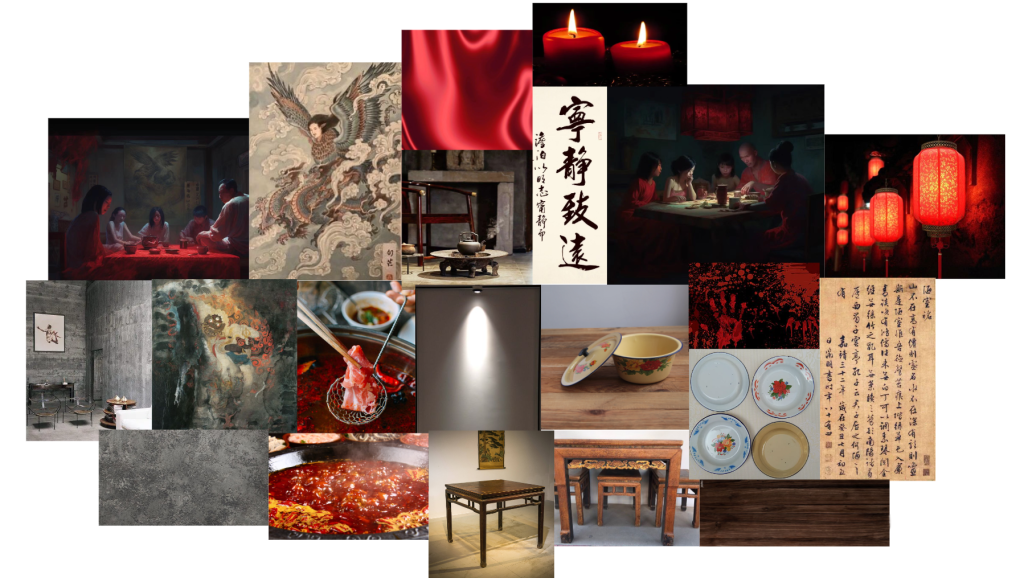
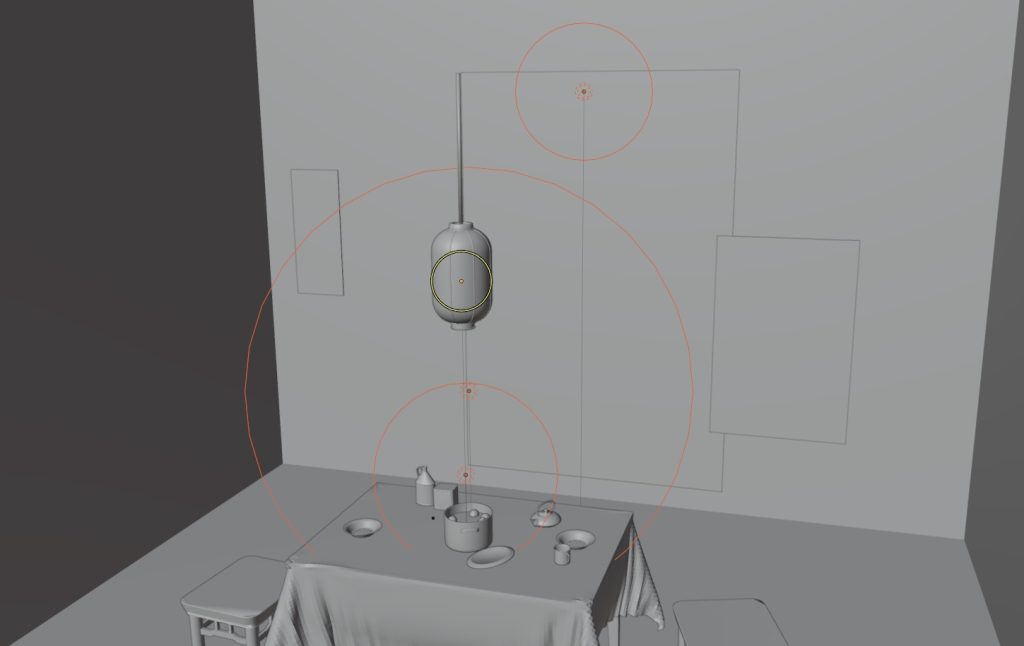
The overall design is minimalist, firstly, because it adheres to the concept of “less is more”, and secondly, because the amount of work is relatively small. There is only one logical light source for the entire scene, right above the dining table, which makes it easier to keep everyone’s eyes focused on the table. Almost all the props in the scene with a Chinese retro style, there is a big Chinese vase in the foreground to add some depth of field. The background is a wall, but designed with some Chinese style paintings and calligraphy. The table and chairs are old-fashioned wood and the tablecloth is made of red silk. The cutlery on it is also in the style that was popular in China in the last century. After setting the overall tone, I started modelling and experimenting with some of the things I didn’t learn in class, such as the use of costume effects.What’s more, I also tried some brushes and plug-ins (although I didn’t end up using them). It has to be mentioned that there are materials on the internet that really make modelling projects efficient and it’s much quicker and easier to get the results you want. After modelling and shading comes the lighting part. This is also one of my favourite parts. The right lighting can give the whole space a more ambient feel. Even though there is only one Logitech light source in the scene, I added four lights. One inside the lantern to give it a glowing look, and one underneath the lantern, which also serves as the main light for the environment. On the table near the eyeball soup, I added a small light as a highlight to make the eyeball soup stand out. Finally, I added a little light at the top of the mural to add some layers and keep the background from being too flat.
The last step is to export the image rendering. Here is the final work.


Bedroom Perspective Exercise
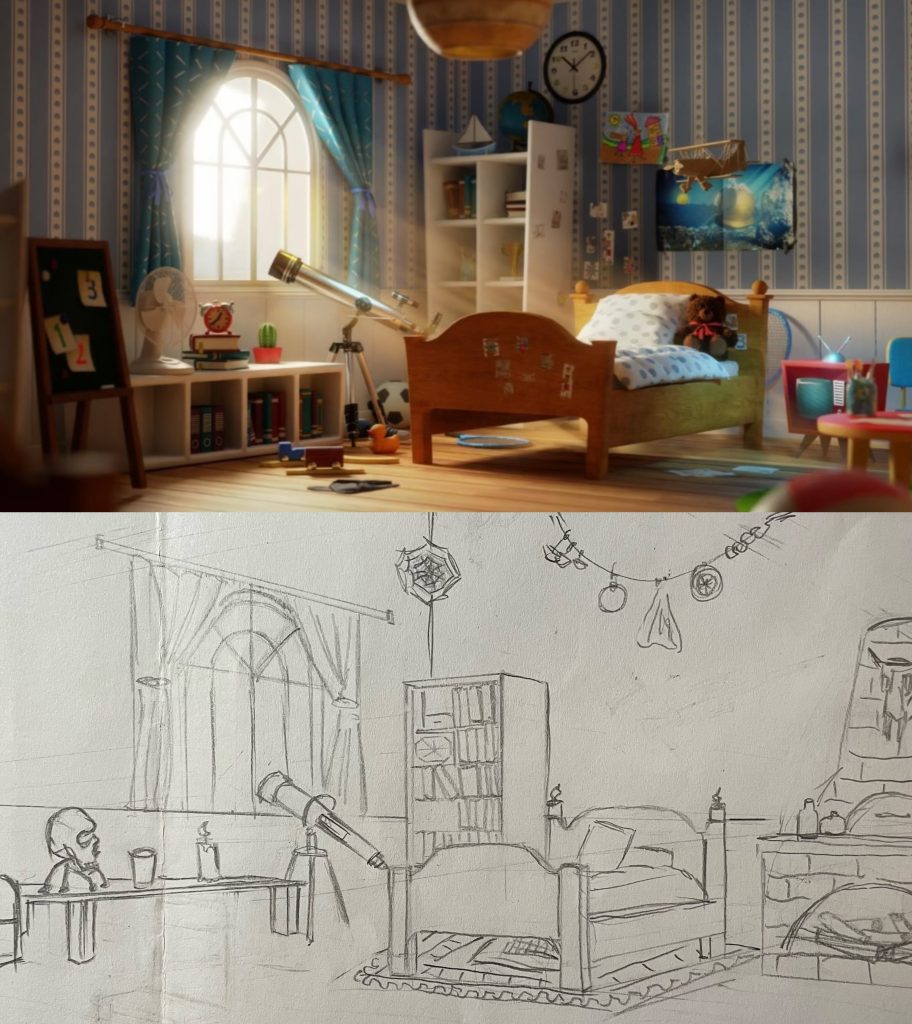
This exercise transforms a picture of a child’s bedroom without changing the position of large objects and following a same perspective relationships. Although we have practised drawing the perspective of objects in the last unit, this is the first time we have drawn a scene with many objects at once. So it wasn’t as easy as I thought it would be. The perspective of the original drawing is not particularly large (the vanishing point is far away), and to be able to draw the same perspective, I chose a larger piece of paper and framed a smaller part in the middle of the paper for the drawing. At the beginning, several large objects were drawn well, but after drawing for a long time, it became a bit impatient, resulting in some small objects that did not follow the perspective very well. I think I need to practice perspective drawing more so I can do it more efficiently, practice makes perfect!
Fish Tank Composition Exercise

This exercise is about drawing different items from a picture into a scene, and design a composition that makes the fish tank the focal point of the picture. Also following in two-point perspective. Firstly, I only came up with the rule of thirds, place the fishbowl in the left third of the painting. Right after that Paul gave me some advice on trying to use some leading lines, such as the point of direction for lamps and plants. What’s more, they can also be used as foregrounds to add depth of field. That’s one move, two gains. With the changes, the drawing looks much better than before. However, I found a perspective problem, Since both the lamp and the plant are too close to the vanishing point, resulting in what will looks super strange. So I ended up having to draw the special perspective of these two objects separately.